NEED HELP FAST? We have over 40 years' experience with Bulk Material Handling, Packaging, and Processing.   (979) 217-1480 GET A QUOTE

NEED HELP FAST?   (979) 217-1480   GET A QUOTE

How to Choose the Right Price Gun Label Rolls?

Choosing the right price gun label rolls affects more than shelf appearance. It influences pricing accuracy, staff speed, and customer confidence. A roll that feeds poorly can leave half-printed labels, loose adhesive, or unreadable numbers. Small defects create larger problems during busy sales periods.

The best price gun label rolls match your gun’s model, label dimensions, core size, and adhesive type. Check the manufacturer’s specifications before ordering. Measure an existing roll if the packaging is missing. Confirm the number of lines, character layout, and print quality required for your products. A narrow label may suit small jars, while a wider format works better on cartons or textured packaging.

Material also matters. Paper labels are affordable and practical for many indoor retail settings. Stronger adhesive may be necessary for cold storage, dusty surfaces, or frequently handled products. Test a small pack first. This prevents waste and reveals whether labels curl, smear, or detach after application. It is easy to focus only on price, but the cheapest roll may cost more through replacement work and delayed selling.

Reliable purchasing depends on more than attractive product photos. Review dimensions, compatibility notes, adhesive performance, and supplier feedback. Ask for technical details when information seems incomplete. Even experienced buyers miss this step sometimes. Keep a sample roll near the pricing station for comparison. With careful checking, you can choose rolls that feed smoothly, print clearly, and remain attached throughout normal handling.
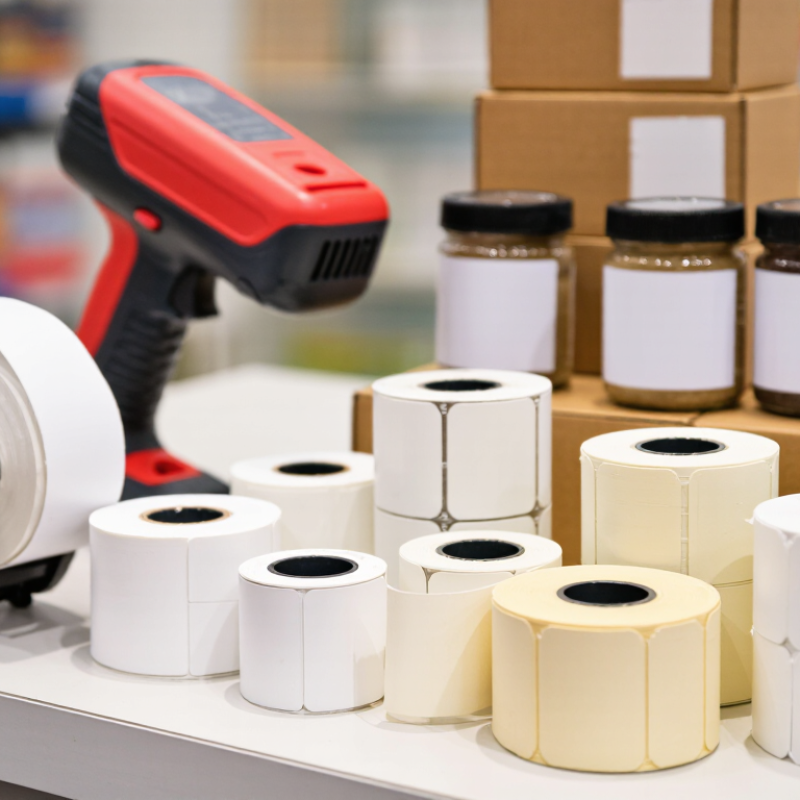
How to Choose the Right Price Gun Label Rolls?

Understanding Price Gun Label Rolls and Their Common Types

Price gun label rolls are not all interchangeable. A roll must match the gun’s core size, label dimensions, feed direction, and printing method.

Manual guns usually apply pre-printed, die-cut labels; electronic models may use direct-thermal stock or thermal-transfer stock. Direct thermal labels darken when heated, so they need no ribbon. They suit quick price changes, but heat and sunlight can fade the print. Thermal-transfer labels use a ribbon and generally last longer. Check the machine manual before ordering. Fit matters.

Adhesive and shape matter, too. Permanent adhesive works well on clean glass or packaging, while removable adhesive may lift more easily from reusable containers. Fluorescent labels stand out on a crowded shelf; white labels keep prices easy to read.

Smithers’ industry report, The Future of Labeling and Product Decoration to 2028, projects the global label market will exceed $50 billion by 2028, reflecting broad demand for labeling materials. That figure covers many label uses, not price-gun rolls specifically.

A small test roll is sensible: adhesive performance can change with dust, cold, or textured surfaces. My first choice would still be the roll specified for the gun. But that rule is not universal.

Identifying Your Price Gun’s Compatible Label Size and Shape

A price gun label roll must match more than the printed label’s width. Check the gun’s manual or product markings for the permitted label dimensions. Then measure a label face and its backing carefully; a roll that looks close may still feed poorly. Small details matter. Note the label shape, such as rectangular or wave-edged, because the gun’s guides and sensor may expect a particular outline. Also verify the roll’s outer diameter, core size, and winding direction if the instructions specify them.

Tips: Remove the old roll and compare it with the replacement before loading. Check that labels peel cleanly from the backing and sit centered beneath the print head. If the gun jams, do not force the roll; confirm its width, shape, and feed direction first.

For a reliable match, use the gun’s stated specifications rather than relying on a label’s appearance alone. A ruler can help, but measure several labels in case the backing is curled or stretched. I have found that people often check width and overlook shape or roll orientation. It is an easy mistake. If details remain unclear, compare the roll dimensions with the manual or ask the supplier to confirm compatibility before ordering.

Checking Label Material, Adhesive, and Print Requirements

How to Choose the Right Price Gun Label Rolls?

Checking Label Material, Adhesive, and Print Requirements

Start with the surface your labels will touch. A smooth glass jar needs different adhesive behavior than a dusty cardboard box. For cold storage, check that the label stays attached after condensation forms. For reusable containers, a removable adhesive may help prevent sticky residue. Test a small roll on your actual packaging before ordering a large supply. It’s a simple step, but easy to skip.

Material affects how labels handle daily use. Paper labels work well for many indoor retail settings and are often easy to print. Synthetic materials can resist moisture and scuffing better, though they may cost more. Consider where the item will sit: a bright window, a chilled display, or a busy checkout counter. Match the material to those conditions, not just the shelf price.

Check the printer and gun specifications before choosing a roll. Confirm the core size, roll width, label dimensions, and winding direction. Then consider what must be printed: clear prices, short product codes, or dates. A label that is too small can make numbers cramped. Print a sample and inspect it under ordinary store lighting. If the ink looks faint or the label feeds unevenly, adjust the format or try another compatible material. Compatibility can be annoyingly specific.

Comparing Roll Capacity, Core Size, and Storage Conditions

A price-gun roll that fits the dispenser can still run out too soon. Compare labels per roll, not just roll diameter. Capacity depends on label length, backing gaps, and the roll’s outer diameter. Ask the supplier for the stated label count, then test a sample during a busy shift. A few extra labels per roll may reduce changeovers, but an oversized roll can rub against the housing. Smithers’ report, The Future of Labels and Release Liners to 2028, tracks continued growth in label use; that broader trend makes practical roll planning more important, though it cannot predict your shop’s daily demand.

Core size matters just as much. Measure the dispenser’s spindle and check its manual before ordering; a loose core may wobble, while a tight one may not load. Don’t assume all price guns use the same core. Storage is easy to overlook. Keep rolls sealed, away from direct sunlight, heaters, and damp floors. Heat can soften adhesive, and moisture can curl the liner. ISO 2233:2000 describes conditioning packaged items under controlled temperature and humidity for testing, a reminder that environment affects packaging performance. It is not a storage rule for every label stock. Test one roll in the actual storage area. The back room might be warmer than expected.

Selecting the Right Rolls for Your Pricing and Inventory Needs

Choosing price gun label rolls starts with the job, not the lowest unit price. Check the gun’s model, label width, roll diameter, core size, and feed direction before ordering. A roll that fits the spindle but curls at the edge can jam during a busy restock. Match adhesive to the surface, too: dusty cartons, chilled packaging, and smooth glass behave differently. Test a small quantity on real products. It is a little inconvenient, but cheaper than relabeling a shelf.

Then consider how labels support pricing and inventory routines. For quick price changes, choose stock that prints clearly and stays attached through handling. If staff scan barcodes, confirm the printed bars remain sharp and the label dimensions suit the code. The National Retail Federation’s 2023 National Retail Security Survey reported average retail shrink of 1.6% of sales for fiscal 2022. That figure is not caused by labeling alone, but it shows why accurate, readable item identification matters. Track roll usage by department and note jams, fading, or adhesive failure. The record may be imperfect at first. Still, it can reveal whether a smaller label wastes less stock—or simply slows the team down.

How to Choose the Right Price Gun Label Rolls? — Selecting the Right Rolls for Your Pricing and Inventory Needs

Typical Label Format Common Label Size Typical Roll Capacity Adhesive and Material Suitable Uses Compatibility Checks
One-line rectangular Approximately 21 × 12 mm About 1,000–1,500 labels per roll Permanent adhesive; paper labels, often available in white or fluorescent colors Basic price marking, short prices, and compact products Check the gun’s supported label dimensions, roll width, core size, and feed direction.
One-line wide format Approximately 26 × 12 mm About 1,000 labels per roll Permanent adhesive; paper suitable for routine indoor retail use Prices or short codes that need more horizontal space Confirm the label width and shape match the gun’s print head and guide path.
Two-line rectangular Approximately 26 × 16 mm About 800–1,000 labels per roll Permanent adhesive; paper labels in plain or fluorescent colors Displaying a price with a date, item code, or other short information Use only with a gun designed for two-line labels; check both label dimensions and print layout.
Large-format rectangular Approximately 32 × 19 mm About 500–800 labels per roll Permanent or removable adhesive; paper options are common Larger products, more visible markdowns, or labels requiring extra print space Verify the gun accepts the larger label and roll diameter; capacity varies with roll construction.
Removable price label Varies by gun, commonly around 21 × 12 mm or 26 × 16 mm About 800–1,500 labels per roll Removable adhesive designed to reduce residue on suitable surfaces Items where labels may need to be removed after purchase or promotion Check the gun’s required label format and test adhesion on the product surface before use.
Fluorescent promotional label Varies by gun, commonly around 21 × 12 mm or 26 × 16 mm About 800–1,500 labels per roll Colored paper with permanent adhesive; colors may include yellow, red, or orange Sale prices, clearance marking, and attention-grabbing shelf or product pricing Confirm the color is compatible with the gun’s label specification and offers sufficient print contrast.

Important: Label sizes and roll capacities are typical examples, not universal standards. Before ordering, check the price gun’s manual or existing roll for label dimensions, core size, roll diameter, label shape, and unwind direction.